Robotic Process Automation solutions are changing the way businesses operate. By handling repetitive, rule-based tasks automatically, RPA allows teams to save time, reduce mistakes, and focus on work that really adds value. When combined with AI for ITSM – ITSM을 위한 AI – and using AI for better customer engagement, these tools help organizations run smoother and create more satisfying experiences for their customers.
Today, cloud-based AI systems make it possible for companies to run their operations more efficiently without relying on heavy, on-site technology. Modern computer systems and smart software help automate everyday tasks, organize data, and make it easier for teams to make informed decisions. Using AI in marketing allows companies to reach the right people with messages that feel personal, while AI-driven online marketing helps track campaign results, optimize content, and improve overall performance.
In finance, intelligent AI tools help companies handle tasks like spotting fraud, preparing reports, and managing risks much faster and more accurately. When combined with robotic process automation solutions, these technologies create a connected system that helps businesses work faster, make smarter decisions, and deliver better results for both employees and customers.
This guide will show you what RPA is, how it works, the key benefits it can bring, and how to start an automation project that actually works and makes a real difference.
Top Contact Center Platforms Leveraging Robotic Process Automation Solutions to Improve Efficiency and Customer Experience
Robotic process automation solutions are transforming contact centers by automating repetitive tasks, improving accuracy, and allowing agents to focus on high-value customer interactions. By combining RPA with AI-powered features, these platforms can handle workflows more efficiently, deliver faster responses, and enhance overall customer satisfaction. Here’s a list of the leading contact center solutions that integrate RPA and AI capabilities:
1. Bright Pattern – Comprehensive AI and RPA Contact Center Solutions
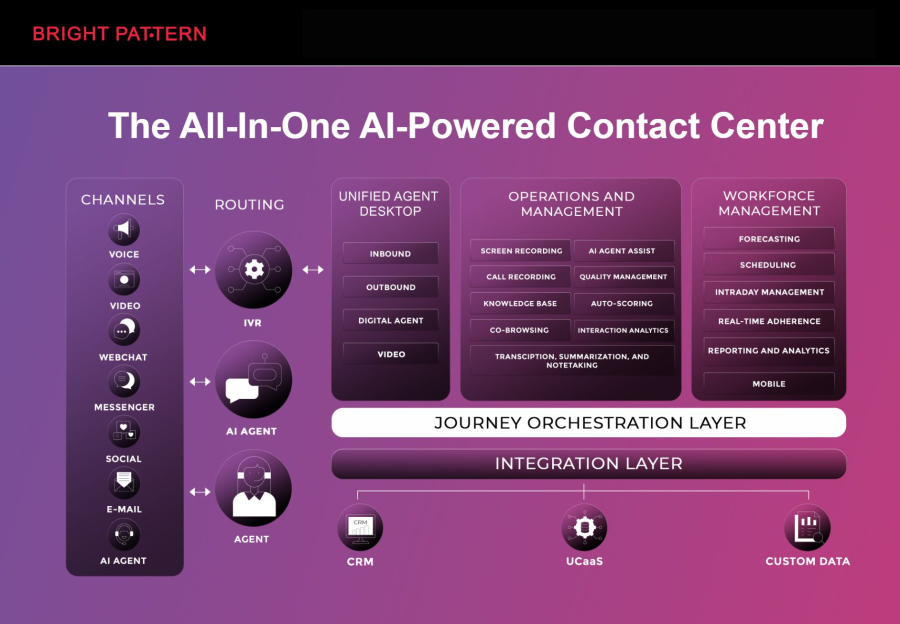
Bright Pattern is a top platform that combines robotic process automation solutions with AI-powered contact center tools, helping organizations deliver seamless customer experiences across multiple channels. Its cloud-based system and easy-to-use interface make it simple to integrate with ITSM platforms and other enterprise software.
Why Bright Pattern Stands Out:
- Omnichannel communication – manage calls, chat, email, and social media in one place
- AI-powered routing – automatically direct customers to the right agent or resource
- RPA automation for repetitive tasks – handle data entry, ticket updates, and follow-ups effortlessly
- Analytics and reporting – get insights to improve agent performance and customer satisfaction
- Cloud flexibility – scale operations quickly without heavy infrastructure costs
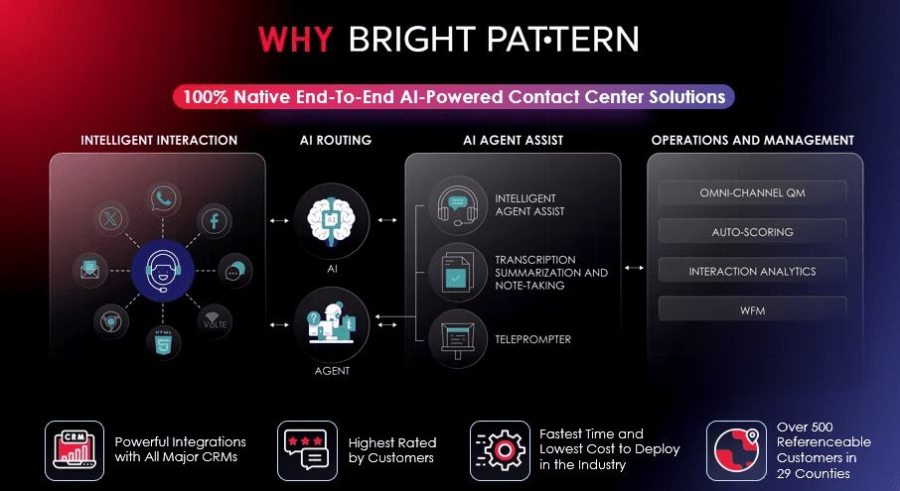
By integrating AI and robotic process automation solutions, Bright Pattern allows contact centers to reduce response times, streamline workflows, and create more personalized customer experiences.
2. Five9 – Cloud Contact Center with Intelligent Automation
Five9 provides a cloud-based contact center platform with AI-driven automation to improve call routing, agent performance, and overall customer engagement.
3. Genesys Cloud – AI-Enhanced Customer Experience
Genesys Cloud uses AI to optimize customer interactions, automate repetitive tasks, and provide predictive analytics to enhance contact center operations.
4. NICE inContact – Advanced RPA and AI Contact Center
NICE inContact combines AI and robotic process automation solutions to improve agent efficiency, automate workflows, and provide actionable insights.
5. Talkdesk – AI and Automation for Smarter Customer Support
Talkdesk leverages AI-driven automation to reduce wait times, improve task management, and increase customer satisfaction across multiple channels.
6. 8x8 Contact Center – Unified Communication with AI
8x8 offers AI-powered automation for customer service across voice, chat, and social platforms, helping teams resolve issues faster.
7. RingCentral Contact Center – Intelligent RPA Solutions
RingCentral integrates AI and robotic process automation solutions to streamline repetitive processes, improve agent productivity, and enhance customer interactions.
8. Cisco Contact Center – Scalable AI and Automation Platform
Cisco Contact Center delivers AI-driven tools to automate tasks, improve routing, and support omnichannel communication.
9. Vonage Contact Center – AI and Automation Combined
Vonage provides AI-enabled automation for managing routine workflows, reducing errors, and enhancing the customer experience.
10. Zendesk – AI-Powered Customer Service Automation
Zendesk integrates AI and robotic process automation solutions to optimize ticket management, analyze customer interactions, and improve support workflows.
What Are Robotic Process Automation Solutions?
Robotic Process Automation (RPA)is technology that uses software "robots" (often called bots) to mimic human actions in digital systems. These bots interact with applications and data the same way a person would: clicking buttons, entering data, copying information, and moving it between systems, but they do it faster, more accurately, and without breaks.
Unlike physical robots on a factory floor, RPA solutions operate entirely in software. They work across your existing systems, such as CRM, ERP, finance tools, web portals, email clients, spreadsheets, and legacy applications.
Key characteristics of RPA solutions
- Rule-based:RPA follows clear, predefined rules and steps.
- Repetitive tasks:Ideal for high-volume, recurring processes.
- System-independent:Works across multiple applications without needing deep integration in many cases.
- Non-invasive:Often does not require changing existing systems or underlying code.
- Scalable:Bots can be ramped up or down based on demand.
How Do RPA Solutions Work?
At a high level, an RPA solution follows a digital "playbook" of steps to complete work. This playbook is usually called aprocess definitionorworkflow. The bot executes each step, interacting with screens and data just like a user.
Typical components of an RPA solution
- Bot designer / studio:A visual or low-code environment where you define the steps of the automation.
- Bot runner / robot:The software robot that executes those steps in real time or on a schedule.
- Orchestrator / control center:A central console to schedule bots, monitor performance, and manage workloads.
- Analytics and reporting:Dashboards to track volume, success rates, processing times, and ROI.
Types of RPA automations
- Attended automation:Bots that work side by side with humans, triggered by the user to assist in real time.
- Unattended automation:Bots that run independently in the background, often on servers or virtual machines.
- Hybrid automation:A combination of attended and unattended bots collaborating across an end-to-end process.
Business Benefits of Robotic Process Automation Solutions
Organizations adopt RPA solutions because they deliver measurable, business-focused results. When well-implemented, RPA can transform day-to-day operations and unlock new capacity across departments.
1. Productivity and speed
- Faster task completion:Bots work much faster than humans at repetitive activities, often 3–10 times faster.
- 24/7 operations:RPA bots can run day and night without breaks, weekends, or holidays.
- Reduced backlogs:High-volume work, such as invoice processing or data entry, can be cleared significantly quicker.
2. Accuracy and quality
- Fewer manual errors:Once configured correctly, bots follow the same steps every time, reducing typos and inconsistencies.
- Reliable compliance:Bots can be programmed to follow internal policies and regulatory rules consistently.
- Better data quality:Clean, accurate data improves reporting, analytics, and decision-making.
3. Cost optimization
- Lower operational costs:Automating routine work reduces the time and effort required to complete it.
- Avoided overtime and temporary staffing:Bots can absorb workload spikes without adding headcount.
- Higher capacity without linear cost growth:You can process more transactions without adding the same proportion of staff.
4. Employee experience and engagement
- Less repetitive work:RPA frees people from time-consuming, low-value tasks such as copy-paste, form filling, and cross-checking.
- More meaningful responsibilities:Employees can focus on customer interaction, analysis, creative work, and problem-solving.
- Reduced burnout:Minimizing tedious tasks contributes to better morale and retention.
5. Scalability and agility
- Respond quickly to demand shifts:Add more bots or adjust schedules to handle seasonal or unexpected spikes in workload.
- Support growth:Enter new markets or roll out new products without proportionally increasing back-office staff.
- Faster process changes:Update bot workflows more quickly than making changes to core systems in many cases.
6. Compliance and audit readiness
- Full traceability:Bots can log every action, timestamp, and data change for easy audit trails.
- Policy enforcement:RPA supports consistent execution of compliance-related steps.
- Reduced non-compliance risk:Lower chance of missed checks or forgotten steps in sensitive processes.
Where RPA Delivers the Biggest Impact: Common Use Cases
RPA solutions shine wherever processes are repetitive, rule-based, and digital. Below are common use cases across departments.
Finance and accounting
- Invoice processing:Extract data from invoices, validate against purchase orders, and enter details into finance systems.
- Accounts payable and receivable:Automate reminders, payment runs, and reconciliations.
- Bank reconciliations:Match transactions between bank statements and internal records.
- Expense report handling:Check completeness, validate rules, and route for approval.
Human resources
- Employee onboarding:Create user accounts, assign system access, and enroll new hires in HR systems.
- Payroll data preparation:Compile time-sheet data and validate information before processing.
- Employee data maintenance:Update records across multiple HR and payroll tools.
Customer service and contact centers
- Case creation and routing:Pull information from emails or web forms and create tickets in helpdesk tools.
- Customer data updates:Sync address or profile changes across multiple systems.
- Knowledge lookup:Retrieve information from various systems so agents can respond faster.
Sales and marketing
- Lead data enrichment:Update CRM records, fill missing fields, and validate contact information.
- Quote and contract preparation:Generate proposals using standardized templates and pricing rules.
- Campaign list management:Cleanse and segment lists based on defined criteria.
Operations and supply chain
- Order processing:Enter orders, validate product availability, and generate confirmations.
- Inventory updates:Sync stock levels between systems and trigger replenishment rules.
- Vendor management:Automate vendor onboarding and data validation steps.
IT and shared services
- Service desk automation:Reset passwords, provision access, and update records automatically.
- Routine monitoring and reporting:Gather logs, generate status reports, and send alerts.
- User provisioning and deprovisioning:Create and remove accounts across multiple systems.
Which Processes Are Right for RPA?
Not every task should be automated, and choosing the right candidates is one of the most important success factors for an RPA program. Strong candidates share similar characteristics.
Ideal traits of an RPA-ready process
- Rule-based:Clear, unambiguous rules with limited judgment or subjective decision-making.
- Repetitive and high volume:Tasks performed frequently and at scale deliver better returns.
- Digital data:Inputs and outputs already exist in digital form (systems, spreadsheets, emails, or forms).
- Stable and standardized:The process doesn't change every week, and steps are largely consistent.
- Low to moderate exception rate:Most transactions follow the same path; exceptions can be routed to humans.
How to discover automation opportunities
- Interview front-line staff:Ask which tasks feel the most repetitive and time-consuming.
- Analyze process logs:Review system logs and reports to find high-volume activities.
- Map current processes:Document end-to-end workflows to identify manual handoffs and data re-entry.
- Prioritize by impact:Consider potential time savings, error reduction, and business importance.
Before and After RPA: A Simple Comparison
The table below illustrates how a typical process can change once RPA is introduced.
|
Aspect |
Before RPA |
After RPA |
|
Processing time per transaction |
Several minutes of manual work |
Seconds, often fully automated |
|
Error rate |
Typos, copy-paste errors, missed steps |
Highly consistent, low error rates |
|
Staff focus |
Repetitive administrative tasks |
Analysis, customer interaction, and innovation |
|
Scalability |
Requires hiring and training more staff |
Scale by adding or scheduling more bots |
|
Audit and compliance |
Manual logs, limited traceability |
Automatic logs, clear digital footprint |
How to Implement RPA Solutions Successfully
Successful RPA initiatives combine the right technology with strong process thinking and change management. A structured approach increases your chances of fast, sustainable results.
1. Define goals and success metrics
- Clarify your objectives:Are you targeting cost reduction, faster cycle times, better compliance, or all of these?
- Set measurable KPIs:For example, percentage of automation, time saved, error reduction, or increase in throughput.
- Align stakeholders:Ensure business leaders, IT, and front-line teams share the same vision.
2. Start with a focused pilot
- Choose a manageable process:Select a well-documented, stable process with clear rules.
- Deliver results quickly:Aim for an automation that can go live in weeks, not many months.
- Use the pilot to learn:Refine governance, standards, and collaboration between IT and business.
3. Design with both business and IT
- Involve process owners:They understand the day-to-day work and edge cases.
- Partner with IT:Ensure secure access, infrastructure, and alignment with broader architecture.
- Document step-by-step workflows:Clear documentation supports robust, maintainable automations.
4. Build, test, and refine
- Develop the bot:Use the RPA platform's designer to replicate the process steps.
- Test extensively:Include typical transactions and exceptions to validate accuracy.
- Fine-tune rules:Adjust handling of edge cases and validation steps before going live.
5. Deploy and monitor
- Roll out gradually if needed:Start with a subset of volume, then scale up.
- Monitor performance:Track volume, success rates, processing times, and exceptions.
- Gather feedback:Ask employees how the automation is affecting their work and refine accordingly.
6. Scale your RPA program
- Create an automation roadmap:Prioritize additional processes based on impact and feasibility.
- Standardize best practices:Establish templates, coding standards, and documentation guidelines.
- Build internal capability:Train citizen developers and process experts to identify and design new automations.
Best Practices for Sustainable RPA
To get long-term value from RPA solutions, treat automation as a strategic capability, not a one-off project.
Engage stakeholders early
- Communicate the vision:Explain how RPA supports people rather than replacing them.
- Involve employees:Front-line staff often know best which tasks can be automated.
- Secure executive sponsorship:Leadership support accelerates decision-making and adoption.
Design for exceptions and handoffs
- Plan human oversight:Define when and how humans will review or handle exceptions.
- Use clear rules for escalations:For example, when data is incomplete or validation fails.
- Ensure continuity:Document who owns each automated process and how it's maintained.
Maintain and optimize continuously
- Monitor changes:When applications or processes change, update bots accordingly.
- Review KPIs regularly:Identify where automations can be enhanced or expanded.
- Retire or redesign:If a process changes significantly, consider redesigning the automation for better fit.
Measuring ROI from RPA Solutions
RPA investments are easier to justify when you can demonstrate clear value. Measuring return on investment (ROI) helps you communicate success and secure support for further expansion.
Key metrics to track
- Time saved:Average time per task before versus after automation, multiplied by transaction volume.
- Error reduction:Number of errors or rework incidents before and after RPA.
- Throughput:Increase in number of transactions processed per day or per month.
- Cost avoidance:Reduced need for overtime, temporary staff, or additional hiring.
- Service levels:Improvements in response time, cycle time, or on-time completion rates.
Qualitative benefits
- Employee satisfaction:Feedback from teams that have offloaded tedious tasks.
- Customer experience:Faster responses, fewer errors, and more consistent service.
- Risk and compliance posture:Stronger audit trails and improved adherence to policies.
Choosing the Right RPA Solution for Your Organization
There are multiple RPA platforms on the market, each with different strengths. Selecting the right solution starts with understanding your needs and priorities.
Key selection criteria
- Ease of use:Intuitive, low-code tools help business users participate in automation design.
- Scalability:Ability to support many bots, processes, and users as your program grows.
- Integration capabilities:Support for your key applications, including legacy and modern systems.
- Security and governance:Robust role-based access, auditing, and compliance features.
- Analytics and monitoring:Built-in dashboards and reporting for real-time performance insights.
- Support and ecosystem:Availability of training, documentation, and partner expertise.
Questions to ask potential vendors or partners
- How quickly can typical automations be designed, tested, and deployed?
- What governance features are available to manage multiple departments and processes?
- How does the platform handle changes in underlying applications or user interfaces?
- What options exist for attended, unattended, and hybrid automation?
- How are security, data privacy, and access controls enforced?
Building an Automation-First Culture
Beyond technology, the most successful organizations treat RPA as part of a broader shift toward automation and digital transformation.
Empower people to identify automations
- Encourage ideas:Create channels where employees can submit automation suggestions.
- Recognize contributions:Celebrate teams whose ideas lead to valuable automations.
- Provide training:Offer basic RPA and process thinking workshops to build awareness.
Align RPA with strategy
- Connect to business goals:Ensure automation projects support growth, customer experience, and efficiency objectives.
- Prioritize high-impact areas:Focus on processes that matter most to your customers and your bottom line.
- Integrate with other initiatives:Combine RPA with broader digital, data, and process improvement programs.
Conclusion: Turning RPA into a Strategic Advantage
Robotic process automation solutions offer a powerful way to transform everyday operations. By automating repetitive, rule-based tasks, you can boost productivity, improve accuracy, reduce costs, and free your teams to focus on the work that truly moves the business forward.
When you choose the right processes, engage your people, and implement RPA thoughtfully, automation becomes more than a technology project. It turns into a strategic capability that supports innovation, scalability, and long-term competitive advantage.
Now is an ideal time to explore where RPA can deliver quick wins in your organization, demonstrate clear value, and build a roadmap toward a more automated, efficient, and resilient future.
